by Scott Frederick | Feb 24, 2026 | Global Logistics Alerts

Fresh off the CSMS press:
CBP Guidance on Imposing Temporary Section 122 Duties
Customs and Border Protection (CBP) late last night, Feb. 23, provided guidance to the trade regarding the Feb. 20, 2026 Presidential Proclamation, “Imposing a Temporary Import Surcharge to Address Fundamental International Payments Problems,” issued pursuant to Section 122 of the Trade Act of 1974 (Section 122), which imposed an additional 10% ad valorem duty on imported articles of every country for a period of 150 days, unless specifically exempt.
Read the full CSMS bulletin here:
CSMS # 67844987 – Imposing Temporary Section 122 Duties
https://content.govdelivery.com/bulletins/gd/USDHSCBP-40b3b7b?wgt_ref=USDHSCBP_WIDGET_2
Continuing the Suspension of Duty-Free De Minimis Treatment for All Countries
Pursuant to the proclamation issued by the President on February 20, 2026, Imposing a Temporary Import Surcharge to Address Fundamental International Payment Problems, effective with respect to goods entered for consumption, or withdrawn from warehouse for consumption, on or after 12:01 a.m. eastern standard time on February 24, 2026, all goods entering the United States regardless of country of origin are subject to an additional 10% import surcharge, unless specifically exempt. Additionally, pursuant to the Executive Order, Continuing the Suspension of Duty-Free De Minimis Treatment for All Countries, issued on the same day, all goods entering the United States regardless of country of origin remain ineligible for the administrative exemption from duty and certain tax at 19 U.S.C. § 1321(a)(2)(C) (“de minimis treatment”), unless they are goods covered by the exception at 50 U.S.C. 1702(b), i.e., certain donations, information/informational materials, and accompanied baggage for personal use.
Read the full CSMS bulletin here:
CSMS # 67845486 – Continuing the Suspension of Duty-Free De Minimis Treatment for All Countries
https://content.govdelivery.com/bulletins/gd/USDHSCBP-40b3d6e?wgt_ref=USDHSCBP_WIDGET_2
Ending Collection of International Emergency Economic Powers Act Duties
Duties imposed pursuant to IEEPA under the following presidential actions, including all modifications and amendments, will no longer be in effect and will no longer be collected for goods entered for consumption or withdrawn from warehouse for consumption, on or after 12:00 a.m. eastern time on February 24, 2026.
Read the full CSMS bulletin here:
CSMS # 67834313 – Ending Collection of International Emergency Economic Powers Act Duties
https://content.govdelivery.com/bulletins/gd/USDHSCBP-40b11c9?wgt_ref=USDHSCBP_WIDGET_2
If you have questions and need assistance, Logistics Plus is here to support you.

by Scott Frederick | Feb 23, 2026 | Testimonials
“Hey Jim, I have been enjoying the great work of different LP team members on Services that are not usual for the company most folks know me by. Your team is awesome and crushing it. From the Erie Warehouse on Pittsburgh Ave to the Credit Department and now possibly international logistics…Wow is all I can say. Shout out to Scott Motter, Jonn Bowersock, Judy Anen, Eric and Jason in the warehouse…Great service and first rate care for a small customer…Then, on Friday, while listening to NPR, I heard one of your staff members comment on the Tariff situation during the national business and money segment….WOW, Jim I hope you hear it all the time: Thanks for being such a great leader and for having such an awesome company here in Erie.”
– Owner/Founder for Creative Services Group
by Scott Frederick | Feb 20, 2026 | Global Logistics Alerts
The Supreme Court ruled TODAY (February 20, 2026) that President Trump’s IEEPA (International Emergency Economic Powers Act) tariffs are unconstitutional.
This case challenged tariffs imposed under the International Emergency Economic Powers Act (IEEPA), which included:
- Fentanyl-based tariffs on China (February 2025)
- Tariffs on Mexico and Canada (February 2025)
- “Liberation Day” global/reciprocal tariffs (April 2025)
Businesses could be owed over $180 billion in refunds after the Supreme Court struck down tariffs. Refunds are top of mind for everyone, but this ruling does not address how they will be administered.
Key Refund Mechanisms:
Option 1: Court of International Trade (CIT) Filings (Most Secure)
- The CIT has confirmed that it has authority in these 1581(i) IEEPA matters to order refunds through reliquidation if the IEEPA tariffs are ultimately held unlawful
- Over 2,000 complaints have been filed by a variety of importers, with filings increasing especially rapidly after the filing by Costco Wholesale Corporation generated considerable press
- The U.S. Government has stated to the CIT that it will not oppose reliquidation of entries that have incurred IEEPA-based tariffs (if they are definitively struck down in a final, unappealable decision), but only for Plaintiffs who have filed Section 1581(i) actions
Option 2: Administrative Protests (CF-19)
- Protests cannot be filed until entries have liquidated. Where CBP acts in a purely ministerial role (arguably, as with IEEPA tariffs), protests may ultimately be rejected
- Less certain pathway than CIT filing
Option 3: Post-Summary Corrections (PSCs)
- For unliquidated entries, PSCs may be an available mechanism to conform entries to the courts’ directives, depending on what the Supreme Court and CIT ultimately order
Limiting IEEPA does not eliminate tariff authority, and trade complexity just got more uncertain.
Expect the Administration’s increased reliance on:
– Section 301
– Section 232
– Section 201
If you have questions and need assistance, Logistics Plus is here to support you.
by Scott Frederick | Feb 13, 2026 | Global Logistics Alerts
Weekly Tariff & Trade Update | Key Moves This Week (Feb 9-Feb 13)
→ US + Taiwan Trade Framework – Tariffs are the headline. Regulatory alignment & semiconductor strategy are the real story.
The US and Taiwan reached an Agreement on Reciprocal Trade that reshapes tariffs, regulatory alignment, and high-tech investment across a $185B trade corridor.
Here is what matters operationally:
US applies the higher of MFN or 15% on originating Taiwanese goods, while certain aligned products are excluded from reciprocal tariffs.
- Taiwan eliminates or reduces 99% of tariff barriers on US goods
Expanded access across autos, machinery, chemicals, electrical products, metals, medical products, and key agricultural categories.
- Non-tariff barriers meaningfully reduced
Taiwan will accept US vehicle safety and emissions standards without additional requirements and accept US FDA authorizations for medical devices and pharmaceuticals.
- Semiconductor and strategic sector alignment deepens
Taiwan companies plan to expand investment in US semiconductors and electronics manufacturing, with preferential treatment in certain Section 232 semiconductor investigations. More than $84B in planned US purchases from 2025 to 2029 across LNG, crude oil, aircraft, and power equipment.
If you operate in semiconductors, autos, medtech, aerospace, energy, or agriculture, this is structural. Your 2026 sourcing model should already reflect it.
- Fact Sheet on U.S.-Taiwan Agreement on Reciprocal Trade
- Presidential Action – ESTABLISHING AN AMERICA FIRST ARMS TRANSFER STRATEGY – securing American dominance across international defense exports.
- JOINT STATEMENT ON A FRAMEWORK FOR UNITED STATES-NORTH MACEDONIA AGREEMENT ON RECIPROCAL, FAIR, AND BALANCED TRADE
- JOINT STATEMENT ON UNITED STATES – BANGLADESH AGREEMENT ON RECIPROCAL TRADE
- UNITED STATES OF AMERICA – ARGENTINE REPUBLIC AGREEMENT ON RECIPROCAL TRADE AND INVESTMENT –
Need more help? Let us know.
by Scott Frederick | Feb 9, 2026 | News
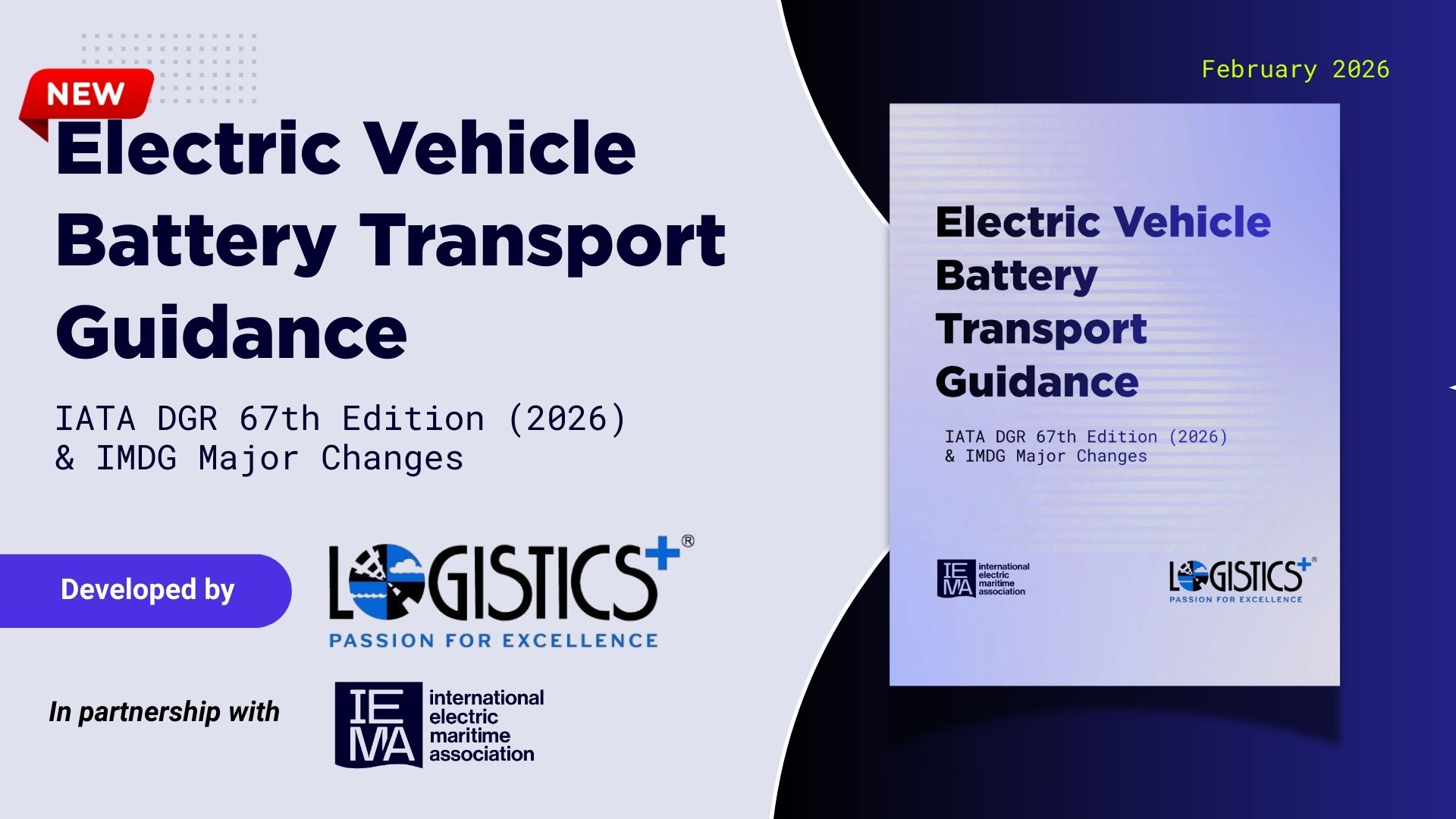 Logistics Plus, Inc. has partnered with the International Electric Marine Association (IEMA) to support the release of updated Electric Vehicle Battery Transport Guidance, aligned with the IATA DGR 67th Edition (2026) and key IMDG Code changes.
The guidance is designed to help shippers, manufacturers, and logistics professionals stay compliant and prepared when handling and transporting battery products across air and ocean modes. To support the broader industry, the updated guidance is now available as a free download.
This collaboration reflects a shared commitment to safety, compliance, and staying ahead of evolving global regulations impacting battery and electric vehicle logistics.
Access the guidance document here: https://lnkd.in/gjFcfVGW